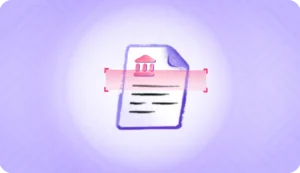







Bank statement analysis is the process of extracting and reviewing transactions, balances, income, expenses, and behavior from a borrower’s bank statements to assess creditworthiness, calculate cash flow, detect fraud, and make faster lending decisions. For banks, NBFCs, and fintechs in India, it is the single highest-leverage step in retail underwriting: the difference between a 30-minute manual review and a 60-second automated decision shows up directly in conversion, throughput, and fraud loss.
Modern bank statement analysis runs entirely on AI. It pulls statements through PDF upload or RBI Account Aggregator framework consent flows, runs bank statement OCR where parsing is needed, categorizes transactions, computes underwriting metrics, and surfaces fraud signals before the file reaches a human. This article walks through the full workflow, the fraud signal taxonomy that catches borrower-side manipulation, and how Account Aggregator integration changes the picture for Indian lenders.
Why bank statement analysis matters in lending
For most retail-credit programs, the bank statement is the single richest source of behavioral and financial information about a borrower. It carries income, regular and one-off expenses, recurring payments, EMI patterns, transfers, savings discipline, and signs of cash-flow stress. Read correctly, it answers the underwriting question without needing additional documents. Read carelessly, it produces approvals that turn into delinquencies six months later.
The underwriting bottleneck
An experienced credit analyst spends 30 to 90 minutes per statement on a thorough manual review. Multiply that across hundreds of applications a day and the hiring math breaks down. The funnel slows, drop-off climbs, and analyst fatigue introduces inconsistency that compliance teams later have to defend.
Where it shows up across lending
Personal loans, business loans, mortgage, MSME, and microfinance all run on bank statement analysis at some stage of underwriting. The depth varies (microfinance leans on shorter windows and proxy signals; mortgage requires longer statements with cross-validation), but the structural need is the same.
Manual vs automated bank statement analysis
The gap between manual and automated review has widened in the last three years.
| Dimension | Manual review | Automated analysis |
|---|---|---|
| Time per statement | 30 to 90 minutes | Under 60 seconds |
| Cost per analysis | High (analyst hours) | Low (per-API call) |
| Consistency | Analyst-dependent, drifts under fatigue | Deterministic, identical across files |
| Fraud detection | Pattern-based, slow, often retrospective | Multi-signal, real-time, layered |
| Scalability | Linear with headcount | Elastic |
| Audit trail | Manual notes, often incomplete | Automated, complete, regulator-ready |
The manual approach still has a role: edge cases, very high-ticket loans, and situations where the system flags low confidence. The 2 to 5 percent of statements that genuinely need human judgment go to a reviewer. The other 95-plus percent get a decision in under a minute.
How automated bank statement analysis works
The full pipeline runs in six stages.
Step 1: Statement ingestion
Two paths now coexist for getting a borrower’s bank data into the analysis pipeline.
PDF and image upload. The traditional path. The borrower uploads statement PDFs (often password-protected) or scans of physical statements. The system handles 1,500-plus bank templates across public, private, foreign, and cooperative banks. Password-protected PDFs are unlocked client-side with the borrower’s consent. Image scans go through a quality-floor check before extraction.
Account Aggregator (AA) ingestion. The newer path, increasingly the default for AA-eligible accounts. Instead of parsing a PDF, the system fetches the underlying transaction data from the borrower’s bank through an RBI Account Aggregator framework consent flow. The data arrives in structured form, signed by the source bank, with no parsing or OCR risk. AA-fetched data short-circuits forgery risk entirely because there is no document to forge.
See Account Aggregator providers in India for the current FIP and FIU landscape and which banks are live on AA.
Step 2: OCR and field extraction
For PDF and image inputs, OCR extracts text fields, transaction tables, headers, footers, and signatures. Modern engines handle template variation across the 1,500-plus Indian banks, regional-language entries on cooperative bank statements, and edge cases like non-standard fonts or low-quality scans. AA-fetched data skips this step entirely; the data arrives structured.
Step 3: Categorization and standardization
Transactions are categorized: salary credits, EMI debits, recurring expenses, business cash flow, ATM withdrawals, GST and tax payments, inter-account transfers. Standardization normalizes the data across bank templates so downstream analysis sees the same shape regardless of source.
Step 4: Fraud signal detection
Five recurring patterns are checked in this stage: round-tripping, salary inflation, EMI bounce patterns, GST and TDS mismatches, and document tamper signals. Detail in the next section.
Step 5: Underwriting metrics
The standard metrics are computed: monthly and annualized income, residual income after fixed expenses, debt-to-income (DTI) ratio, NSF (non-sufficient funds) count, average and minimum balances, salary stability, and business cash flow ratios for self-employed borrowers. See credit underwriting for the underwriting view and automating credit assessment memos for the downstream CAM stage.
Step 6: Output to LOS / LMS
Structured JSON output goes into the Loan Origination System or Loan Management System. APIs are typically plug-and-play; the integration shape depends on the LOS vendor. Audit trails are retained for regulator inspection. See HyperVerge’s bank statement analysis API for integration details.
Fraud signals to look for in bank statements
Borrower-side manipulation falls into five recurring patterns. Modern bank statement analyzers flag all five automatically, but underwriting teams should know what they are looking at.
Round-tripping and circular transfers
Money that moves out of an account and returns within days, often through one or two intermediary accounts, inflates apparent cash flow. The pattern shows up as paired credit and debit entries of similar size with short time gaps, often through the same counterparty. Automated analyzers detect circular flow even when intermediated through multiple accounts within a single ecosystem. See big-data fraud detection for the broader pattern-detection model.
Salary inflation and synthetic-employment patterns
A genuine salary lands on a predictable date (1st, 7th, end-of-month) from a single employer, with TDS deducted at source and reflected as a single line. Inflated salary entries often arrive at irregular dates, from individual or proprietorship accounts rather than corporate accounts, with no TDS deduction visible. Cross-checking against PAN-NSDL TDS data closes the loop.
EMI bounce and NSF pattern detection
A single bounce is noise; a pattern of bounces is signal. Recurring NSF on EMI dates, paired with a top-up from an unrelated account a day or two later, indicates structural cash-flow stress masked by month-end balance management. The DTI metric alone misses this; bounce-pattern analysis catches it.
GST and TDS mismatch with declared income
For self-employed borrowers and small businesses, declared bank-statement income should reconcile against GST and TDS data. Significant mismatches (claimed business income with no GST registration, or GST returns showing far smaller revenue than statement deposits) are common manipulation patterns and recurring fraud markers across types of financial fraud.
Document tamper signals
Font, alignment, and layout anomalies, computed-balance mismatches (where running balance does not match transaction sums), missing pages, and inconsistent print quality across pages all indicate post-issuance editing. Pixel-level forensics catches edits that visual review misses. See document forgery and tamper detection for the broader detection model.
Account Aggregator integration: the India differentiator
India’s Account Aggregator (AA) framework is now mainstream for retail and SME lending. Any bank statement analysis tool that does not fetch AA-sourced data is operating on an incomplete picture.
What the AA framework is
The AA framework, regulated by the RBI under the NBFC-AA license category, is a consent-based financial data sharing infrastructure.
- Financial Information Providers (FIPs) hold the data: banks, mutual funds, insurance companies, GST.
- Financial Information Users (FIUs) consume it: lenders, advisors, wealth managers.
- Account Aggregators are the regulated intermediaries that broker consent and route data between the two, without seeing the data themselves.
Why AA matters for bank statement analysis
Three properties make AA-sourced data superior to PDF parsing for any account that supports it:
- Tamper-proof at source. Data is fetched directly from the bank’s systems, signed cryptographically, and routed through the regulated AA. There is no document to forge.
- Consent-based and revocable. The borrower controls what data is shared, for how long, and can revoke at any time. DPDPA-compliant by design.
- Structured, machine-ready. No OCR. No edge cases. No “the bank changed their PDF template last month and our parser broke.”
When PDF parsing still wins
AA coverage is high but not complete. PDF parsing remains the right path for:
- Cooperative banks and Gramin banks not yet live on AA
- NRI accounts where AA is not yet supported
- Business accounts where AA coverage is patchy
- Pre-AA-window historical statements (older than the AA-supported lookback window)
The pragmatic answer is dual-path: AA where available, PDF where not. See HyperVerge’s Account Aggregator integration for the operational view.
Cooperative banks, Gramin banks, and passbook handling
Rural and microfinance lending depends on bank statement formats that the urban-fintech vendor stack often ignores.
Why cooperative and Gramin statements are different
Many cooperative banks and Regional Rural Banks (RRBs) issue handwritten passbooks rather than printed statements. Some use regional language entries (Marathi, Tamil, Bengali) for transaction descriptions. Some issue statements that lack standard fields (no MICR code, no IFSC, no transaction reference number). Most are not yet on AA.
A tool that handles only printed statements from public-sector and private banks misses a large share of the borrower base in tier-3 towns and rural India. A tool that handles handwritten passbooks, multilingual entries, and non-standard formats opens microfinance and Gramin lending segments that digital underwriting otherwise cannot reach. See personal bank statement analysis for the retail-side view.
Microfinance and rural lending workflow
The practical microfinance flow combines passbook scanning, regional-language OCR, and field-level reconstruction (rebuilding a standardized statement from non-standard inputs). Cross-validation against NBFC customer onboarding signals (Aadhaar, PAN, voter ID, sometimes only one of the three for genuine first-time borrowers) compensates for the thinner financial record.
Best practices for lenders
Five practices separate effective bank statement analysis programs from ones that just check a compliance box.
Define a minimum statement period upfront
Decide whether you need 3, 6, or 12 months of statements based on product risk and borrower segment. Inconsistent demand creates churn at onboarding and weakens the analysis. Most retail-credit programs settle on 6 months as the standard window.
Use AA wherever the borrower’s bank supports it
AA-sourced data is faster, fraud-proof, and DPDPA-compliant by design. Default to AA; fall back to PDF only when AA fails or is not supported.
Combine bank statements with GST, ITR, and credit bureau data
Bank statements alone tell part of the story. Cross-referencing with GST returns, ITR filings, and credit bureau records (CIBIL, Experian, CRIF) closes the gaps a single source leaves open. Lenders running multi-source underwriting see materially lower delinquency than those relying on bank statements alone. See loan origination for the broader workflow integration.
Monitor model drift quarterly
Fraud patterns evolve. The signals that mattered in 2023 (basic round-tripping) are now table stakes; the signals that matter in 2026 (AI-generated synthetic statements, GST-PAN mismatch patterns, AA-spoofing attempts) need ongoing model retraining. Run a model performance review at least quarterly.
Maintain a documented exception protocol
When a statement fails automated checks, what happens next matters. A documented protocol (escalate to second reviewer, request additional documents, decline with reason code) keeps the funnel auditable and avoids ad-hoc decisions that DPDPA and RBI inspections will flag.
Common mistakes during bank statement analysis
The recurring failure modes worth designing against.
Treating low-balance months as red flags without context
A single low-balance month for a salaried borrower paying off a large planned expense (school fees, medical, marriage) is not the same as a chronic low-balance pattern. Context-aware thresholds beat hard rules.
Missing inter-account transfers and double-counting income
A borrower who maintains both a salary account and a savings account may transfer income between them, which a naive analysis double-counts. De-duplicating across accounts, or netting transfers, is essential when the borrower submits multiple statements.
Over-relying on stated income without statement reconciliation
Stated income on the application form should match what the bank statements show. Mismatches over a defined threshold (typically 10 to 15 percent) should trigger a review, not an automatic decline.
Ignoring document integrity checks
Even with a strong fraud signal taxonomy, skipping the document-integrity layer (font, layout, balance recomputation, metadata) leaves a gap that sophisticated borrowers can exploit. The integrity check belongs at ingestion, before transaction analysis runs.
How to choose a bank statement analysis tool
Five criteria matter most.
Coverage of bank templates and AA support. How many banks does the tool handle on PDF parsing? Is AA coverage live and complete for major Indian banks? What is the fallback when one path fails? See bank statement analysis software for the broader buyer view.
Accuracy and audit-grade extraction. Ask for false-positive and false-negative benchmarks on real volume mixes. Audit-grade means every extracted field is traceable back to the source line in the original statement, viewable on demand.
Fraud detection depth. Round-tripping, salary inflation, EMI bounces, GST mismatches, document tampering. The full taxonomy. A tool that flags only one or two patterns is missing the others.
LOS and LMS integration fit. Plug-and-play APIs, structured JSON output, mobile and web SDKs, batch processing for high-volume programs. Integration friction is where many implementations stall.
Compliance fit for India. RBI KYC Master Direction 2025, ISO 27001, DPDPA-aligned consent and data minimization, regulator-ready audit trails. See HyperVerge’s bank statement analysis for Indian lenders for the India-specific stack.
See HyperVerge bank statement analysis in action
For Indian lenders, the right bank statement analysis stack is the difference between a 30-minute funnel and a 60-second one, between catching borrower fraud at onboarding and chasing it in collections. Account Aggregator integration, regional-language OCR for cooperative bank statements, and the full fraud signal taxonomy come together as one stack.
Talk to our team about bank statement analysis to see how it fits your underwriting flow.
FAQs
What is bank statement analysis?
Bank statement analysis is the process of extracting and reviewing transactions, balances, income, expenses, and behavior from a borrower’s bank statements to assess creditworthiness, calculate cash flow, detect fraud, and make faster lending decisions. Modern systems automate the full pipeline (ingestion, OCR, categorization, fraud detection, metric computation) and return underwriting-ready output in under a minute.
Why is bank statement analysis important for lenders?
Bank statements carry the single richest signal on a borrower’s actual cash flow, expenses, and financial discipline. Read correctly, they answer the underwriting question without additional documents. Lenders that automate this layer cut underwriting time from 30 to 90 minutes per case to under 60 seconds, while catching fraud patterns (round-tripping, salary inflation, EMI bounces) that manual review misses.
How is bank statement analysis automated?
The automated pipeline runs six stages: ingestion (PDF upload or AA fetch), OCR and field extraction (skipped for AA), categorization and standardization, fraud signal detection, underwriting metric computation, and output to the LOS or LMS. AA-fetched data is structured at source and avoids OCR; PDF parsing handles the rest. The full process completes in under a minute per file.
What is the difference between manual and automated bank statement analysis?
Manual review takes 30 to 90 minutes per statement, varies by analyst, and produces inconsistent audit trails. Automated analysis returns the same output in under 60 seconds, runs deterministically across files, and generates regulator-ready audit trails. Manual review still has a role for edge cases and high-ticket loans (typically the 2 to 5 percent of cases that need human judgment); automation handles the rest.
What insights can be extracted from bank statements?
Income and salary stability, recurring expenses, EMI patterns, debt-to-income ratio, NSF count, average and minimum balances, business cash flow ratios for self-employed borrowers, transfer patterns, and fraud markers (round-tripping, salary inflation, document tampering). Modern systems also surface behavioral signals: spending discipline, savings rate, geographic patterns, and counterparty relationships.
How long does bank statement analysis take?
An automated analysis on a 6-month statement returns underwriting-ready output in well under a minute, typically 15 to 45 seconds depending on file size and bank template. Manual review of the same statement averages 30 to 90 minutes for an experienced analyst. The gap is why every retail-credit program at scale has automated this layer.
What fraud signals can be detected from bank statements?
Modern automated analyzers detect five recurring fraud patterns: round-tripping and circular transfers (paired credit and debit entries through intermediary accounts), salary inflation and synthetic-employment patterns (irregular dates, non-corporate sources, missing TDS), EMI bounce and NSF patterns paired with same-day top-ups, GST and TDS mismatches with declared income, and document tampering signals (font anomalies, balance recomputation failures, missing pages).
How accurate is automated bank statement analysis?
Modern systems extract structured data from 1,500-plus bank templates with high accuracy on printed statements; cooperative bank passbooks and handwritten or multilingual entries are harder and require specialized handling. Account Aggregator data, where available, is structured at source and avoids OCR error entirely. The remaining uncertainty concentrates in low-quality scans, non-standard formats, and edge-case categorization decisions, all of which are routed to human review.